


Stability ball exercises
Balance and strength training for the core, back, upper and lower body.
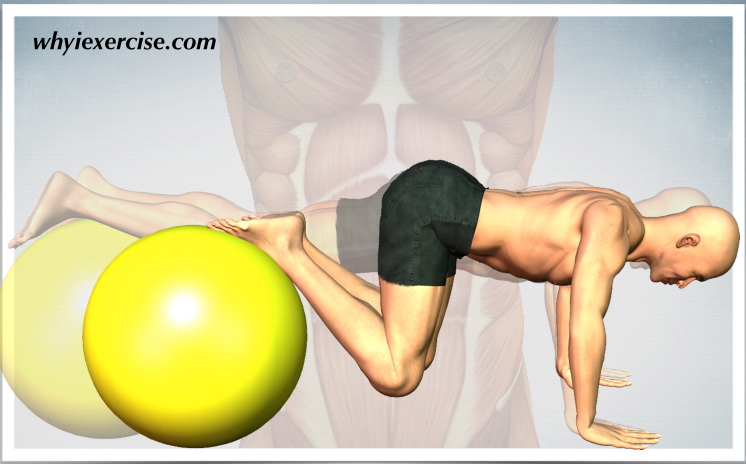
Stability ball exercises add an element of balance to body weight exercise routines. Current research supports this type of workout for a greater core training effect. Please be safe with these unstable exercises! Follow the instructions, illustrations and videos closely to maintain good body alignment during this intermediate level routine.
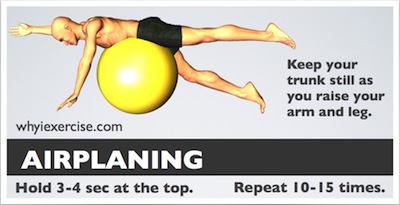
#1 Airplaning
Position yourself with your navel over the center of the stability ball. Extend your L leg back first and then reach your R arm forward, maintaining a steady trunk. Hold 3-4 seconds, stretching as far as you can with your L leg and your R foot. Lower your arm and leg and repeat. Once you can keep the ball still during the exercise, raise your opposite arm and leg at the same time.
Repeat up to 15 times.
#2 Double knee to chest
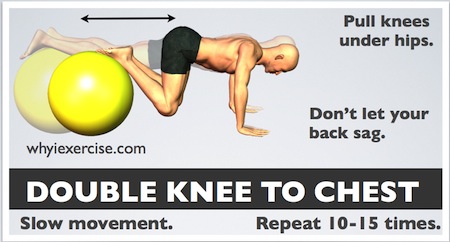
Begin in push up position as shown with your feet on the ball and hands at shoulder width. Maintain a closed umbrella so your body remains straight and your back doesn’t sag as in the picture to the left. Next, with straight arms, pull your knees toward your chest, rolling the ball forward under your feet. Then return to the start position. Straighten your legs fully with each repetition.
Repeat up to 15 times.
*Note: Using a foam roll under your hands, as shown in the video below is significantly less stable than having your hands on the floor. This is only a demonstration. Do not try the stability ball exercises with a foam roll under your hands unless you have advanced training experience.
My complete guide to core exercise is now available! Reprogram your core muscles and work your way through 6 levels of training (beginner to advanced)! Order my new e-book, Progressive Core Strengthening.
#3 Hamstring curls
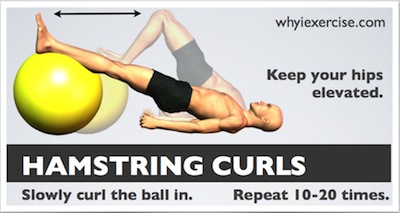
Put your feet up on a stability ball as shown. With your arms on the floor to help you balance, lift your waist up to form a straight line from your shoulders to your knees. Hold this position and curl the ball underneath your legs. Don’t let your body sag toward the floor during the exercise. Straighten your legs all the way and repeat. If this exercise is difficult, start by balancing with straight legs, then do small curls and work your way up.
Repeat up to 25 times.
#4 Lever push ups
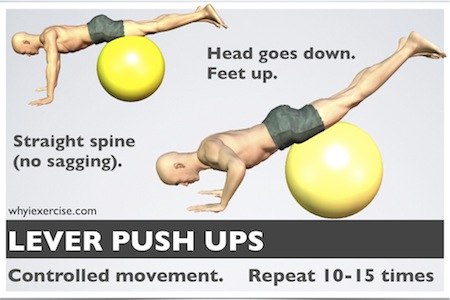
This exercise teaches you to involve your core muscles in push ups, so that your body does not sag and stress your spine. Keep your body in a straight line over the ball. Your feet go up as your head goes down, and vice versa. Emphasize good body position at first, then work on going through the full range of motion as shown. As with standard push ups, you can adjust your hand position to focus on different muscle groups (hands close together for triceps emphasis). Repeat up to 15 times.
Repeat 10-15 times.
#5 Ball pass
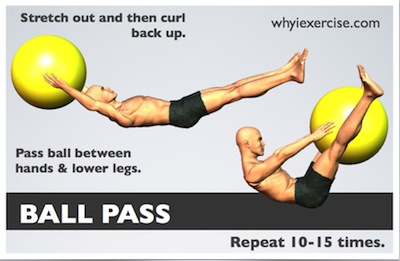
Place a stability ball between your knees / lower legs, straighten your legs and curl up into a crunch position. Next, take the ball with your hands, reach your arms straight back and lower your legs forward as shown, forming a banana shape, as shown above. The further you reach, the more challenging the exercise. Return to the start position the same way you came, and pass the ball to your legs. Stretch out once again to a banana shape, this time holding the ball between your legs, and return to start.
Repeat 10-15 times.
Workout boost
For a longer, full body workout, try combining this routine with any of 3 other workouts listed in my free home exercise programs article. Resistance band exercises and body weight exercises are upper and lower body combo routines, and my knee strengthening exercises article focuses on the hip, thigh and leg muscles. Pair any of these routines with the stability ball exercises above and you'll have a 25-30 minute workout. You can also try the bonus exercise below.
#6 Jackknife
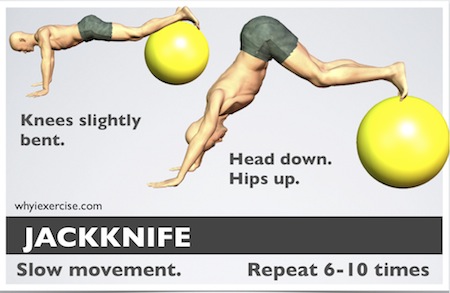
This move is the most challenging of the stability ball exercises in this article. Pull the ball underneath you so that your hips go up and your upper body goes down. This exercise emphasizes the lower abdominals, the deltoids, and the trapezius. Keep your knees slightly bent to avoid excessive hamstring stretch during this exercise. A more advanced version, shown in the video, is to pull up to a semi-vertical position.
Repeat up to 10 times.
Related articles
Back strengthening exercises
Exercise routine for the deep muscle layers that support the spine, including all 4 abdominal muscle groups. This is a great introduction to developing a strong, balanced midsection.
Pilates sample exercises
Step up the intensity from the above strengthening program. As the exercises become more challenging, using correct form becomes even more critical. The videos help you learn and develop greater control over your body movements.
Knee strengthening exercises
Target the thigh, hip, gluteus, and calf muscles that work together to support and control the knee joint. Improve your balance and muscle tone while reducing your risk of injury.
Back stretching exercises Relieve muscular tension and restore balance between the spine and hip muscles. As you improve your flexibility in key muscle groups, such as the hamstrings and abdominals, you will reduce the strain on your spine. This effective routine includes 7 illustrated stretches.
Resources
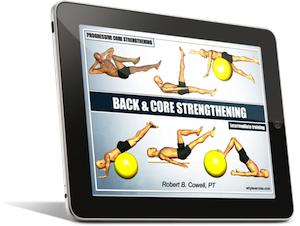
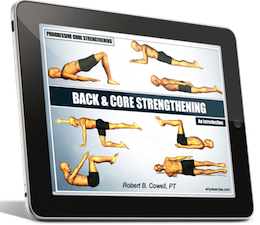
PROGRESSIVE CORE STRENGTHENING Overcome your core training plateau with my interactive e-book! Progressive Core Strengthening includes 56 exercises and 6 graduated core workouts. Corrective exercises, anatomy diagrams and weekly training guidance are packaged in an easy-to-navigate system. (Created in .pdf format.)
Intermediate Back & Core Strengthening In line with current research on core training and unstable surfaces, the workouts in this book incorporate the stability ball, foam roll and several movement variations for a greater challenge to the core muscles.
Introductory Back & Core Strengthening Are you new to core exercise? Start with a solid foundation. Get 8 weeks of guided training from the introductory routines in the book, Progressive Core Strengthening. The workouts are based on rehab and fitness exercises that have helped the author's physical therapy clients for years.
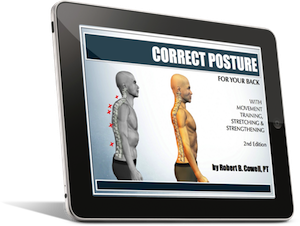
CORRECT POSTURE Find out whether you have good standing posture, and then correct it! Stretch out the muscles that affect your posture the most. Understand and master the safest core exercise methods with my original e-book!
Return from stability ball exercises to free home exercise programs.
Return to home page: Why I exercise.