


How to Measure VO₂ Max: Watch Estimate, Walk Test, or Run Test?

Your smartwatch says your VO₂ max dropped. But your workouts feel strong and your endurance is improving. The numbers don't match reality.
This is rarely a training problem, it’s a measurement problem.
Wearable devices, walking tests, and running tests estimate VO2 max in fundamentally different ways. The same person can get conflicting numbers depending on the measurement, and understanding why helps you choose the test that matches your goals. The assessment below makes that match based on your current training and fitness level.
VO₂ Max Test Finder
Answer 3 quick questions to get your VO₂ max test recommendation — plus a research-backed cardio fitness rating.
Studies link higher self-rated fitness with healthier blood pressure, lower inflammation, and longer life expectancy. * Holtermann et al. 2015; Moissl et al. 2025
These questions use your current cardio habits, self-rated fitness, and response to brisk walking to recommend a VO₂ max test.
Your best next test
Self-rated fitness is more than perception. It predicted cardiovascular and all-cause mortality even after accounting for activity level, general health, walking pace, and traditional risk factors.
Compared with people who rated their fitness higher than peers, those rating themselves the same as peers had 1.8 years lower life expectancy, while those rating themselves lower had 5.1 years lower life expectancy.
High self-rated fitness has been associated with lower blood pressure, lower blood sugar, lower inflammation, and better cholesterol profiles — independent of age, sex, and other health conditions.
Your self-rating is meaningful enough to take seriously, but not objective enough to stop there. Use it as a signal, then confirm your baseline with a field test.
In one study, adding self-rated fitness to traditional cardiovascular risk factors improved CVD mortality prediction by 30.5% — suggesting it captures something standard assessments miss.
About the Studies
- Holtermann et al. (2015): Copenhagen City Heart Study (n=8,936). Participants rated their cardiorespiratory fitness relative to peers. Self-rated fitness predicted CVD mortality and life expectancy over 15-year follow-up, independently of self-rated health, walking pace, and leisure-time physical activity.
- Moissl et al. (2025): Population study using an 11-point self-rated fitness scale. Linked higher self-rated fitness to lower cardiovascular and all-cause mortality, and to favorable markers including blood pressure, HbA1c, fasting glucose, and inflammatory proteins (hsCRP, IL-6). Associations held in participants both with and without documented coronary artery disease.
References
Holtermann A, Marott JL, et al. Self-reported cardiorespiratory fitness: prediction and classification of risk of cardiovascular disease mortality and longevity — a prospective investigation in the Copenhagen City Heart Study. J Am Heart Assoc. 2015;4(1):e001495. doi: 10.1161/JAHA.114.001495.
AP Moissl, GE Delgado, et al. Self-rated physical fitness predicts cardiovascular and all-cause mortality — implications for clinical decision-making. European Journal of Preventive Cardiology, 2025; zwaf154. https://doi.org/10.1093/eurjpc/zwaf154
This assessment and scoring system are proprietary tools developed by Rob Cowell, PT.
For educational use only — do not reproduce commercially.
How Smartwatch VO₂ Max Often Differs from Walk or Run Tests
Smartwatches use exercise heart rate and pace to calculate VO₂ max estimates. GPS reliably measures pace, but typical exercise conditions (see chart below) often interfere with the watch's heart rate sensor. Even small heart rate errors can lead to notable differences in estimated VO₂ max.
This highlights the challenge of getting reliable fitness estimates under variable, real-world training conditions.
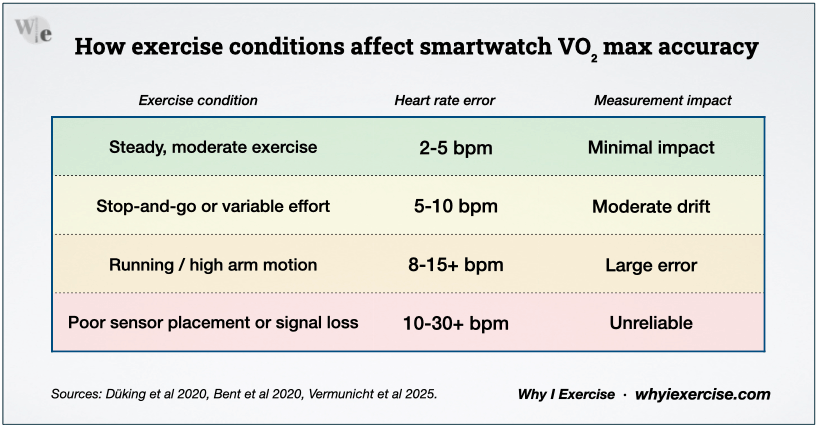
These limitations help explain why smartwatch estimates, field tests, and laboratory measurements can all produce different results for the same person.
Smartwatch Estimate, Walking Test, Or Running Test? How To Decide.
The three options below offer different strengths and trade-offs depending on your current fitness level and what matters most to you right now.
#1: Smartwatch Estimate
Use a smartwatch estimate if all of these apply:
- You exercise mostly at steady, moderate intensities
- You value ongoing convenience over single-point precision
- You accept the measurement limitations during variable or intense training
#2: Rockport Walk Test
Use the Rockport Walk Test if all of these apply:
- You want reliable accuracy without a maximum-effort test
- You can walk at a fast pace for a full mile
- You aren't a runner or highly trained athlete
Complete the Rockport Walk Test, calculate your VO₂ max →
#3: Cooper Test (Running)
Use the Cooper Test if all of these apply:
- You want running-specific accuracy and can handle intense effort
- You can run for at least 12 minutes or 1.5 miles
- You prefer a performance-based score, the kind used in fitness and longevity research.
- You're in good cardiovascular health or have medical clearance
Learn how to run the Cooper Test and estimate your VO₂ max →
Frequently Asked Questions
These questions address common points of confusion around VO₂ max measurement, including smartwatch estimates, field tests, and how to choose the right method for your routine.
What if I'm between two testing categories?
Start with the easier option. Rockport provides reliable baseline data, and you can progress to a Cooper test later once you've confirmed your cardiovascular readiness. If you're a runner but concerned about maximum effort, another valid approach is a submaximal Cooper test. Complete the 1.5-mile or 12-minute run, and calculate your VO2 max. If your submaximal effort puts you in the age-group category that matches your goal, you know your cardio training is on track.
Why did my watch VO₂ max drop during my hardest training?
During intense efforts, heart-rate sensors on smart watches can lose the signal. Rapid arm movement, stop-and-go effort, and sensor contact issues produce heart-rate readings that drop 20-30 bpm or more from the expected level. When your heart-rate data is off, the VO₂ max estimate becomes unreliable. If you need a VO₂ max score during a heavy training period, a field test under controlled conditions will give you a more reliable baseline.
How accurate is the Rockport Walk Test?
The Rockport test shows typical error around 4-5 ml/kg/min compared to laboratory VO₂ max in the non-athlete, working-age adult population it was designed for. Accuracy is strong when you walk briskly and continuously and measure your heart rate accurately after the test. Accuracy decreases in highly trained athletes and in older or very sedentary groups where the original VO2 max equations may not fit as well.
How accurate is the Cooper Run Test?
The Cooper 12-minute run and 1.5-mile run show typical individual error of 3-6 ml/kg/min. Accuracy depends on producing a genuine best performance, which requires adequate warm-up, even pacing, and running-specific fitness. The test works best for fit adults who can tolerate a near-maximal effort. For people unable to perform a high-end effort safely, the Rockport test is usually more appropriate.
How accurate are smartwatch VO₂ max estimates?
Smartwatch VO₂ max estimates can show relatively low average errors in controlled validation studies. But in real-world personal use, many readings are substantially over- or underestimated.
Typical individual errors can exceed ±10 ml/kg/min depending on workout conditions, heart-rate sensor accuracy, and the device’s algorithm.
Accuracy is highest during steady, moderate-intensity exercise with good sensor contact. It decreases during variable-intensity training, running with high arm motion, or other conditions that disrupt heart-rate readings.
Bottom line: Field tests are better for establishing a reliable VO₂ max baseline and determining health-risk categories. Smartwatches are best used to track fitness trends over time, especially during steady, moderate-intensity training.
Ready To Get Your VO₂ Max Baseline?

About the author
Rob Cowell, PT, the founder of Why I Exercise (est. 2009), is a physical therapist with 29 years of clinical experience. He specializes in evidence-based fitness, movement coaching, and long-term conditioning, and he maintains high personal fitness through running, calisthenics, and beach volleyball.
Evidence Summary
Heart-Rate Sensor Accuracy by Exercise Condition
The heart-rate error ranges in this article reflect findings from validation studies of wrist-based optical sensors across different exercise intensities and conditions. Under controlled, steady-state exercise, wrist-worn devices typically show errors of 2-8 bpm. During variable-intensity training or activities with substantial arm motion, errors commonly increase to 5-15+ bpm. Poor sensor placement or signal loss can cause transient errors exceeding 20 bpm, making derived VO₂ max estimates unreliable.
Shcherbina, A., Mattsson, C.M., et al (2017). Accuracy in Wrist-Worn, Sensor-Based Measurements of Heart Rate and Energy Expenditure in a Diverse Cohort. Journal of Personalized Medicine, 7(2). https://doi.org/10.3390/jpm7020003
Bent, B., Goldstein, B.A., et al (2020). Investigating sources of inaccuracy in wearable optical heart rate sensors. npj Digital Medicine, 3(18). https://doi.org/10.1038/s41746-020-0226-6
Düking, P., Fuss, F.K., et al (2020). Wrist-Worn Wearables for Monitoring Heart Rate and Energy Expenditure While Sitting or Performing Light-to-Vigorous Physical Activity: Validation Study. JMIR mHealth and uHealth, 8(5). https://doi.org/10.2196/16716
Vermunicht, P., Buyck, C., et al (2025). Optimization and pre-use suitability selection for wrist photoplethysmography-based heart rate monitoring in patients with cardiac disease. European Heart Journal - Digital Health, 6(5), 1024-1035. https://doi.org/10.1093/ehjdh/ztaf084
Smartwatch VO₂ Max Estimation Accuracy
Accuracy ranges for smartwatch VO₂ max estimates cited in this article are based on validation studies comparing wearable device outputs with laboratory measurements.
Lambe, R., O'Grady, B., et al (2025). Investigating the accuracy of Apple Watch VO2 max measurements: A validation study. PLOS One, 20. https://doi.org/10.1371/journal.pone.0323741
Jamieson, A., Jones, S., et al (2024). Comparison between Smartwatch-Derived and CPET-Measured VO2Max. Computing in Cardiology Conference (CinC). https://doi.org/10.22489/cinc.2024.352
Field Test Validation
Rockport Walk Test accuracy estimates are based on the original validation and subsequent independent replications using the same protocol. Across studies, typical error remains in the ~4–6 ml/kg/min range when the test is performed as designed.
Kline, G.M., Porcari, J.P., et al (1987). Estimation of VO2max from a one-mile track walk, gender, age, and body weight. Medicine & Science in Sports & Exercise, 19(3), 253-9. PMID: 3600239
Dolgener, F.A., Hensley, L.D., et al (1994). Validation of the Rockport Fitness Walking Test in college males and females. Research Quarterly for Exercise and Sport, 65(2), 152-8. https://doi.org/10.1080/02701367.1994.10607610
Grant, S., Corbett, K., et al (1995). A comparison of methods of predicting maximum oxygen uptake. British Journal of Sports Medicine, 29, 147-152. https://doi.org/10.1136/bjsm.29.3.147
Roeykens, J., Rys, K., et al (2001). Does the Cooper Test Accurately Predict the VO2max? Medicine & Science in Sports & Exercise, 33(5), S302.
Penry, J., Wilcox, A., et al (2011). Validity and Reliability Analysis of Cooper's 12-Minute Run and the Multistage Shuttle Run in Healthy Adults. Journal of Strength and Conditioning Research, 25, 597-605. https://doi.org/10.1519/jsc.0b013e3181cc2423