


Rockport Walking Test Calculator & VO₂ Max Charts

Your smartwatch might show a VO₂ max of 38, but that measurement is from an algorithm, not a standardized test. The Rockport 1-Mile Walk Test estimates VO₂ max from a defined effort: a fast, steady one-mile walk and your post-walk heart rate.
The Rockport Test is research-validated and included in professional fitness assessment guidelines. It's designed for working-age adults who prefer a brisk walk over running to gauge their fitness.
Rockport converts your walk time and heart rate into a score you can compare against age- and sex-specific health standards. You can complete it in about 20 minutes with a quick warm-up, walking one mile at your fastest sustainable pace, immediate heart rate measurement, and calculator entry.
How the Rockport Test Measures VO₂ Max
VO₂ max is estimated from your walk time, heart rate, age, sex, and body weight using the standard Rockport (Kline-Dolgener) equation.
View calculation formula
VO₂max = 132.853
         - (0.0769 × Weight in lbs)
         - (0.3877 × Age)
         + (6.315 × Gender)
         - (3.2649 × Time in minutes)
         - (0.1565 × Heart Rate in bpm)

Gender: 0 = female, 1 = male
Use the calculator below to convert your test result instantly. No manual calculation needed.
Prep tips for the Rockport Walking Test
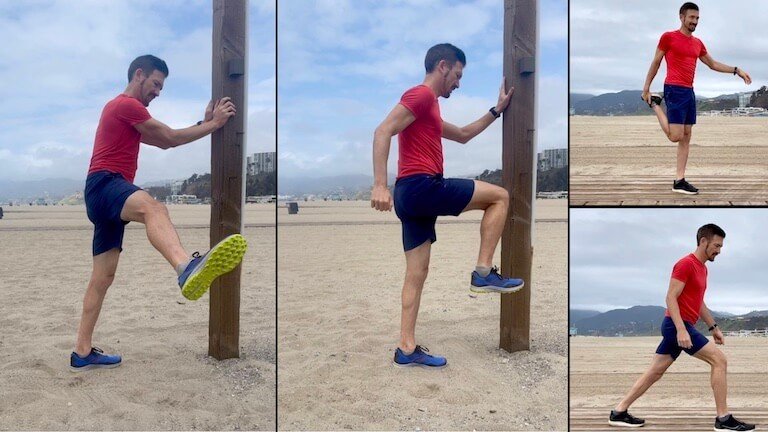
1) Your best test results require walking at your top speed. A good warm-up will boost your circulation and activate your muscles before you begin.
Try a brief light-to-medium effort walk, followed by active mobility exercises and stretching. The image shows side leg swings, hip flexion with a rear arm swing, plus quad and calf stretching.
2) Power-walking can also help you maximize your walking speed. The faster your speed, the stronger your exertion and the more accurate your score will be.
If you haven't practiced power-walking technique, you may find that you can walk faster than you think.
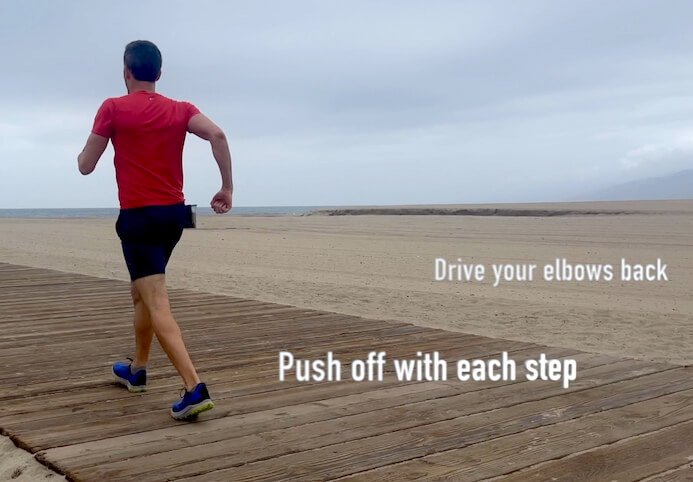
 Pick a flat, low traffic route for the test.
3) Do you have a good route picked out? Avoid hills or traffic, which would increase your heart rate or slow you down. You can use a track, a treadmill set at 1% grade, or a fitness watch to measure the one-mile distance.
4) Before you start the test, practice taking your pulse to be sure you’ll get an accurate score. With your palm facing up, place your fingers over the thumb side of your wrist, just to the inside of your wrist tendons.
Press in gently and feel for your pulse.
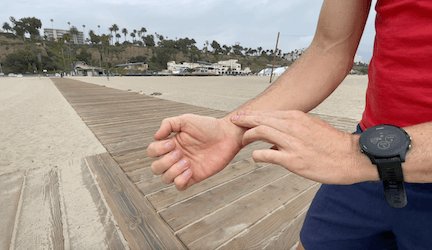 Take your pulse for 15 seconds right after the one-mile walk.
Directions for the Rockport Walking Test
- Start your timer and begin walking at your fastest sustainable pace.
- Maintain a steady, strong effort for the full mile—avoid starting too fast or fading.
- At the finish, stop your timer and immediately take your pulse for 15 seconds.
- Multiply your pulse count by 4 to get your heart rate in beats per minute.
- Enter your walk time and heart rate into the calculator.
Calculate Your VO₂ Max (1-Mile Walk → VO₂ Max)
Complete the 1-mile walk test, then enter your results above to see your estimated VO₂ max and fitness age. The calculator uses the Kline-Dolgener formula to convert your walk time, heart rate, age, sex, and body weight into a score you can track over time.
Your result provides a transparent baseline—not an algorithm-adjusted estimate. This gives you a clear reference point for measuring cardiovascular improvement and understanding your current fitness status.
Rockport VO₂ Max Calculator
Complete the 1-mile walk test and calculate your score below.
Your Score Gives You a Starting Point. Now Build From It.
That does not mean you need hard training right away. The next step is to understand what your result means for your daily routine and start with the simplest changes that actually move the needle.
What a Low VO₂ Max Means (and the 3 Small Changes That Move It)Not sure your result is accurate? Quick baseline guidance here
Prefer a ready-made system that adapts day-by-day? See the Cardio Override Quick Start
Methodology & Sources
How Your VO₂ Max Is Estimated:
Research Citations
Fitness Classifications
Tier categories based on age and sex-adjusted percentiles from population fitness studies (Mandsager et al., 2018; Kokkinos et al., 2022).
Note: This calculator uses age-optimized equations for enhanced accuracy across all age groups. The Dolgener equation prevents overestimation in young adults (ages 18-22), while the Kline equation remains the gold standard for adults 23+.
Age-group scoring charts for the Rockport Walking Test
The charts below show VO₂ max ranges by age group and fitness category. Find your age in the left column, then scan across to see where your calculated score falls—from Poor through Superior fitness levels.
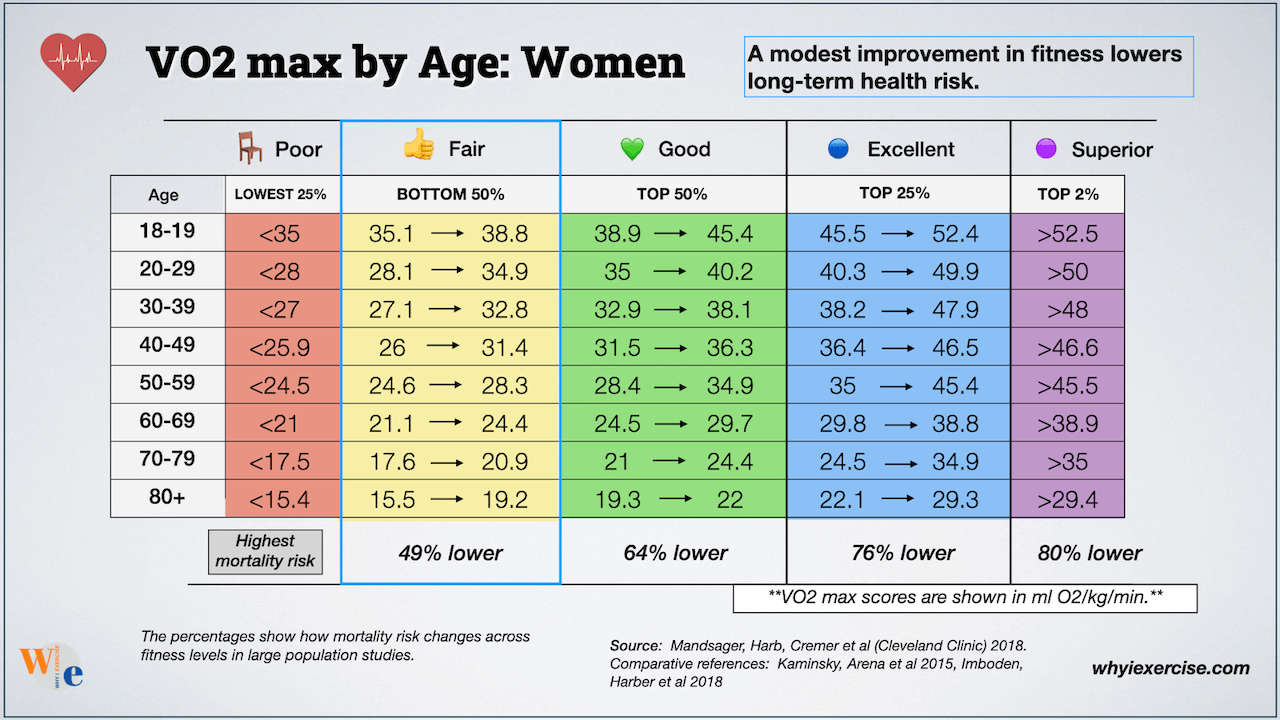 Age-based VO₂ max ranges for women and men associated with long-term health outcomes.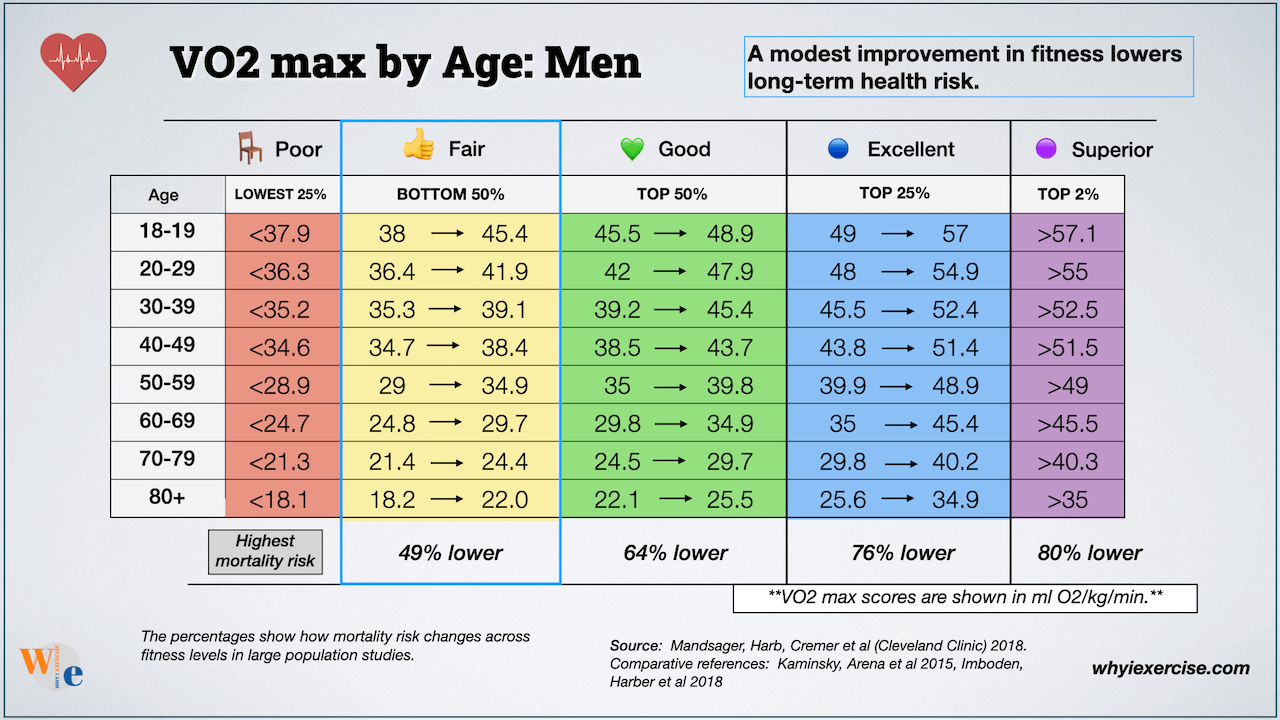
Use these charts to set realistic improvement targets. Moving from Poor to Fair, or Fair to Good, represents meaningful cardiovascular health gains. Your score gives you a baseline you can retest every three months to track fitness changes over time.
The Rockport Walking Test gives the most accurate results for non-athlete working-age adults. If a one-mile brisk walk would be very easy for you, even at a power walking pace, you’ll get a more accurate score from maximum effort tests like the Cooper 1.5-mile or 12-minute run.
The 3-Minute Step Test is another reliable cardio testing option, though it will not give you a VO2 max score.
Power walking technique for the Rockport walking test.
See the difference between power walking and brisk walking.
With an aggressive arm swing and intentional push-off, power walking recruits more muscle groups to help propel you forward. My top walking speed over a mile increased from 4.3 to 4.9 mph by switching from brisk walking to power walking.
Keep your elbows bent 90 degrees and drive your elbows back. Intentionally push off the ball of your foot with each step. Throughout the walk, stay tall and keep your gaze forward. Use power walking for the test only if you feel comfortable with it. You want to hold a steady pace for the entire mile.
Conclusion
The Rockport Walking Test is the most accurate walking-based fitness test to estimate your VO2 max. Using the methods described in this article, you can get a reliable fitness measurement to compare to healthy standards for your age group.
Once you know your score and peer-level fitness rating, you can use it to guide your training. The articles below explain why VO₂ max matters, what a low score may mean, and how to improve your cardio fitness through structured exercise and everyday activity.
- Start here: Why VO₂ Max Matters for Health and Fitness →
- Understand more: What a Low VO₂ Max Actually Means →
- Move the number: How to Improve Your VO₂ Max →
Not Sure Your Current Training Is Actually Moving The Needle?
Baseline Checkpoint reads your training consistency alongside your VO₂ score and gives you a clear answer — whether you're maintaining, need to rebuild, or are ready to progress.
Quiz → VO₂ Analysis → Composite Report.

About the author
Rob Cowell, PT, the founder of Why I Exercise (est. 2009), is a physical therapist with 29 years of clinical experience. He specializes in evidence-based fitness, movement coaching, and long-term conditioning, and he maintains high personal fitness through running, calisthenics, and beach volleyball.
References
1) Kline GM, Porcari JP, Hintermeister R, Freedson PS, Ward A, McCarron RF, Ross J, Rippe JM. Estimation of VO2max from a one-mile track walk, gender, age, and body weight. Med Sci Sports Exerc. 1987 Jun;19(3):253-9. PMID: 3600239.
2) Mandsager K, Harb S, Cremer P, Phelan D, Nissen SE, Jaber W. Association of Cardiorespiratory Fitness With Long-term Mortality Among Adults Undergoing Exercise Treadmill Testing. JAMA Netw Open. 2018 Oct 5;1(6):e183605. doi: 10.1001/jamanetworkopen.2018.3605. PMID: 30646252; PMCID: PMC6324439.
3) Dolgener FA, Hensley LD, Marsh JJ, Fjelstul JK. Validation of the Rockport Fitness Walking Test in college males and females. Res Q Exerc Sport. 1994 Jun;65(2):152-8. doi: 10.1080/02701367.1994.10607610. PMID: 8047707.
4) Fenstermaker KL, Plowman SA, Looney MA. Validation of the Rockport Fitness Walking Test in females 65 years and older. Res Q Exerc Sport. 1992 Sep;63(3):322-7. doi: 10.1080/02701367.1992.10608749. PMID: 1513964.
5) McSwegin, P.J., Plowman, S.A., Wolff, G.M., & Guttenberg, G.L. (1998). The Validity of a One-Mile Walk Test for High School Age Individuals. Measurement in Physical Education and Exercise Science, 2, 47-63.
6) Arizona State University, Healthy Lifestyles Research Center, Compendium of Physical Activities, https://sites.google.com/site/compendiumofphysicalactivities/home
7) Rospo G, Valsecchi V, Bonomi AG, Thomassen IW, van Dantzig S, La Torre A, Sartor F. Cardiorespiratory Improvements Achieved by American College of Sports Medicine's Exercise Prescription Implemented on a Mobile App. JMIR Mhealth Uhealth. 2016 Jun 23;4(2):e77. doi: 10.2196/mhealth.5518. PMID: 27339153; PMCID: PMC4937178.
8) Duck-chul Lee, Enrique G Artero, Xuemei Sui and Steven N Blair, Mortality trends in the general population: the importance of cardiorespiratory fitness, Journal of Psychopharmacology 24(11) Supplement 4. 27–3, Available from http://jop.sagepub.com/content/24/4_suppl/27.long
9) Xuemei Sui, MD, Steven P. Hooker, PhD, et al, A Prospective Study of Cardiorespiratory Fitness and Risk of Type 2 Diabetes in Women, Diabetes Care December 10, 2007, available from http://care.diabetesjournals.org/content/early/2007/12/10/dc07-1870
10) Xuemei Sui, Michael J. LaMonte, and Steven N. Blair, Cardiorespiratory Fitness as a Predictor of Nonfatal Cardiovascular Events in Asymptomatic Women and Men; American Journal of Epidemiology, Vol. 165, No. 12; available from www.ncbi.nlm.nih.gov/pubmed/17406007
11) Ming Wei; James B. Kampert; Carolyn E. Barlow; et al., Relationship Between Low Cardiorespiratory Fitness and Mortality in Normal-Weight, Overweight, and Obese Men; JAMA. 1999;282(16):1547-1553; Available from http://jama.ama-assn.org/cgi/content/full/282/16/1547
Return from Rockport walking test to physical fitness tests.
Return to home page: Why I exercise.