


VO₂ Max Charts by Age: What Your Score Actually Means

Where does your fitness stand for your age?
The charts below answer that directly. Locate your age group in the left column, then scan to the right to see where your score lands.
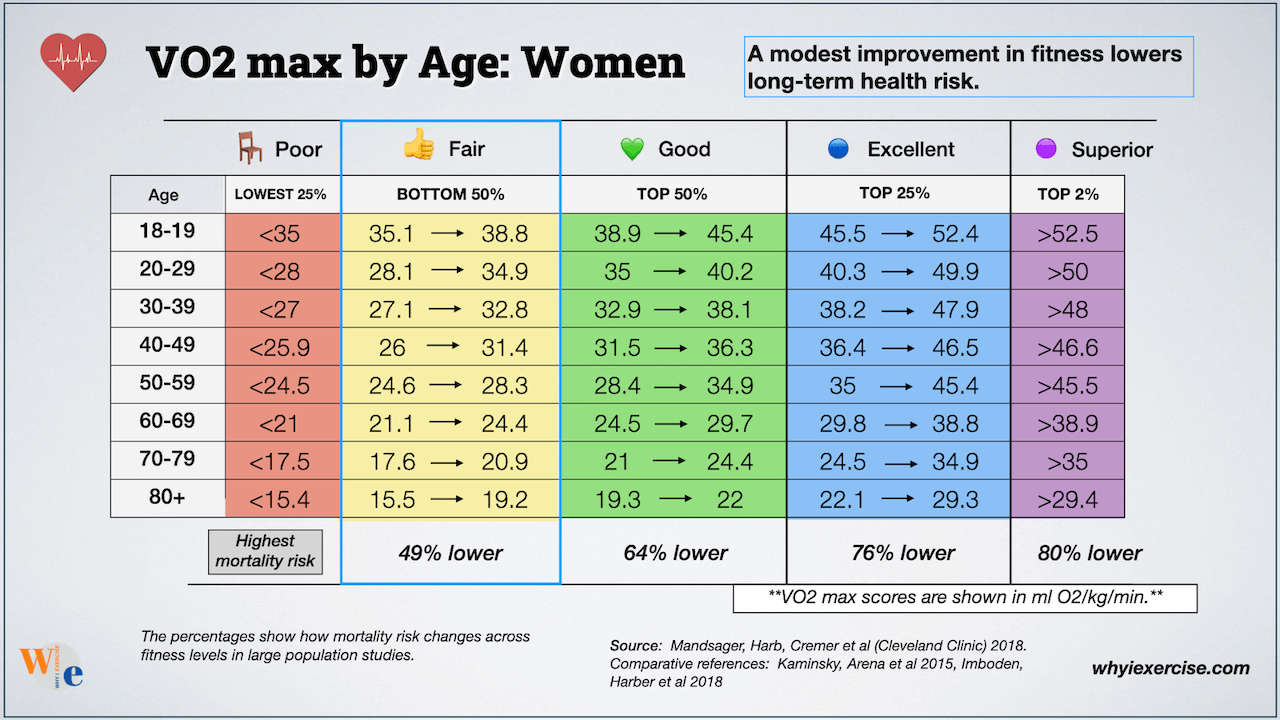 Age-based VO₂ max ranges associated with long-term health outcomes.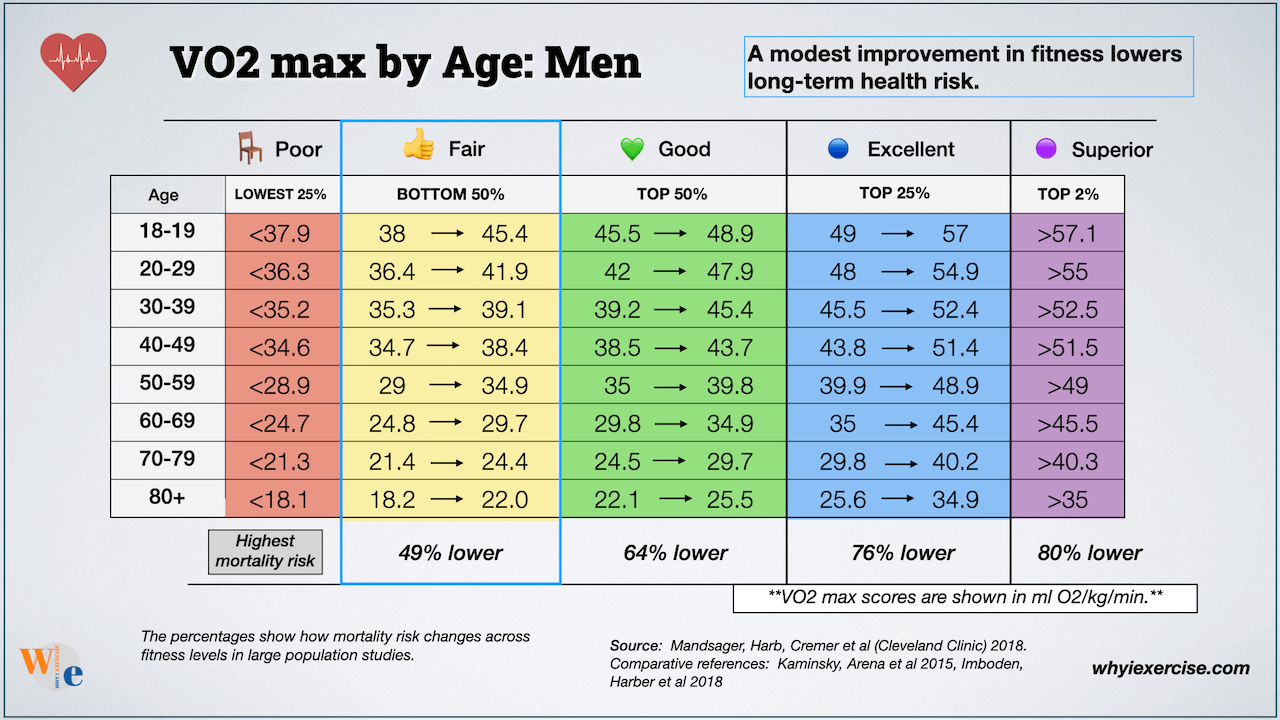
Much of the meaningful health protection tied to VO₂ max appears by the 50th percentile for your age.
Above that line, you’re building a performance buffer for more energy in workouts and daily life. Below it? Small gains can shift your placement quickly. Calculate your score below.
Cooper Test VO₂ Max Calculator
Complete either the 12-minute run or 1.5-mile run test to calculate your VO₂ max below.
🎯 You Took the Test. Now See Where You Stand.
Your VO₂ max shows your current fitness level. Baseline Checkpoint shows what to focus on next.
Get Your Complete Assessment → $9Immediate access. Quiz → VO₂ Analysis → Composite Report.
By using this tool, you agree to our Terms of Use.
What's included in Baseline Checkpoint? ▸
A VO₂ score tells you where you stand. Baseline Checkpoint shows you what to do about it.
The Cardio Quiz evaluates how your current training holds up in practice. You get a named training tier, a profile, and guidance matched to your goal.
The VO₂ Analysis compares your fitness to health and performance standards. You get your VO₂ max score, a medal tier anchored to health-protective thresholds, and your age-based percentile ranking.
Your quiz and VO₂ results are read together. You get your position on the fitness-age curve and a clear training emphasis: maintenance, rebuilding, or progression.
One direction. Not a list of possibilities.
Immediate access. Quiz → VO₂ Analysis → Composite Report.
🔬 Methodology & Sources
How Your VO₂ Max Is Estimated:
Research Citations
Fitness Classifications
Tier categories based on age and sex-adjusted percentiles from population fitness studies (Mandsager et al., 2018; Kokkinos et al., 2022).
Note: This calculator uses the original Cooper test formulas validated across multiple populations. The 12-minute test works well for all fitness levels, while the 1.5-mile test is preferred for those who can maintain steady running pace.
Need a walking-based test? The Rockport Walking Test gives the same accurate VO₂ max and fitness age estimate using a brisk 1-mile walk instead of running.
Take the Rockport Walking Test →How VO₂ Max Changes With Age and Why It’s Not Fixed
VO₂ max typically peaks in your late 20s to early 30s. After that, the average decline is about 10% per decade. That shift is consistent across large population studies.
The curve trends downward with age, but performance within each age group varies widely. The contrast across decades makes this clear:
- A fit 55-year-old outperforms an average 35-year-old.
- An athletic 55-year-old can match a fit teenager.
- A sedentary 55-year-old trails a fit 75-year-old.
That separation within the same decade is what fitness age captures.
What Your VO₂ Max Score Says About How You're Aging
Picture two 47-year-olds hiking the same trail. One, with a VO₂ max of 45, climbs steadily and recovers quickly at the summit. The other, at 35, is working noticeably harder to maintain the same pace.
They share a birth year, but not the same physiological age. One reflects the fitness of someone in their mid-30s. The other resembles someone in their late 50s. This gap isn’t theory. It’s measurable.
Fitness age is an estimate of your cardiovascular age relative to peers, based on VO₂ max. It isn’t fixed. It reflects your current trajectory.
Got your fitness age from our VO₂ max calculator? Your number is today’s snapshot. Baseline Checkpoint shows where it’s heading →
What to Do If Your Score Is Low, or You Want to Move Up
A below-average score is common. It is also responsive to training.
Research consistently shows meaningful health gains with even modest improvements in VO₂ max, especially when starting below average. The same effort that shifts your score upward often makes everyday activity feel easier: less fatigue at a given pace and steadier recovery between efforts.
Your body’s systems are built to adapt. The same biology that permits decline also allows for substantial improvement with consistent exercise.
Choose your next step:
How to Measure Your VO₂ max
If you don’t know your number yet, the next step is simple: take a field test and estimate it.
If you’re newer to structured training or prefer a lower-impact option, use the Rockport Walking Test. It estimates VO₂ max from a one-mile walk and heart rate response.
If you’re comfortable running at sustained effort, use one of the Cooper running tests. They estimate VO₂ max from either a 12-minute effort or a 1.5-mile run.
- Estimate with the Rockport Walking Test →
- Estimate with the Cooper 12-Minute Run →
Not sure which fits you?
Take the 60-Second Cardio Fitness Assessment →
Frequently Asked Questions
What is a good VO₂ max for my age?
A good VO₂ max for your age is one that places you at or above the 50th percentile for your sex and age group. That’s where most of the foundational health protection is captured. Higher percentiles add protection and performance capacity; supporting more active, independent years as you age. Use the charts above to locate your age group and see where your number falls.
Does VO₂ max decline with age?
Yes. VO₂ max typically peaks in early adulthood and declines about 10% per decade. That general trend is consistent across large population studies, though longitudinal studies show a smaller decline in early adulthood that accelerates well above 10% per decade after retirement age (3, 4). However, people of the same age can differ substantially based on training history. The decline is real, but the steepness of your personal trajectory is influenced by how you train.
Is Apple Watch VO₂ max accurate for my age?
Wearables estimate VO₂ max using heart rate and movement data. They can track trends over time, especially during steady efforts, but they are indirect estimates. Field tests such as the Rockport Walk or Cooper Run are highly reliable, performance-based measurements based on validated formulas. If you want a reproducible baseline, start with a structured field test.
Why is my VO₂ max low even though I exercise?
A low score does not always reflect low effort. It may reflect the type of training you do, the intensity you reach during testing, or the method used to estimate it. If your score surprised you, review how it was measured and whether the test matched your actual capacity.
Can I improve my VO₂ max after 50?
Yes. VO₂ max responds to training at every decade. While age-related decline occurs on average in the general population, individuals can still improve their scores with consistent aerobic training. Even modest increases are associated with meaningful health gains, particularly when starting below average. The direction of change matters more than your starting point.
What is cardio fitness age?
Cardio fitness age is an estimate of how your cardiovascular capacity compares to others your age, based on VO₂ max. Two people of the same chronological age can have very different fitness ages depending on their score. It reflects your current position and can shift over time as your training changes. You can calculate yours inside Baseline Checkpoint.

About the author
Rob Cowell, PT, the founder of Why I Exercise (est. 2009), is a physical therapist with 29 years of clinical experience. He specializes in evidence-based fitness, movement coaching, and long-term conditioning, and he maintains high personal fitness through running, calisthenics, and beach volleyball.
References
1) Lee, D.C., Artero, E.G., Sui, X. and Blair, S.N. (2010) "Mortality trends in the general population: the importance of cardiorespiratory fitness." Journal of Psychopharmacology, 24(11) Supplement 4, pp. 27–35.
2) Mandsager K, Harb S, et al. Association of Cardiorespiratory Fitness With Long-term Mortality Among Adults Undergoing Exercise Treadmill Testing. JAMA Netw Open. 2018 Oct 5;1(6):e183605.
3) Hawkins, S., & Wiswell, R. (2003). Rate and Mechanism of Maximal Oxygen Consumption Decline with Aging. Sports Medicine, 33, 877-888.
4) Fleg, J., Morrell, C., Bós, Â., et al (2005). Accelerated Longitudinal Decline of Aerobic Capacity in Healthy Older Adults. Circulation, 112, 674-682.